Spinal deformities can affect both children and adults, with scoliosis being one of the more commonly seen conditions. Scoliosis may occur at birth or develop later in life due to degeneration and aging. Treatment options vary depending on age, severity of the spinal curve, and overall medical condition, and may range from growth-friendly techniques in children to decompression and fusion procedures in adults.
Scoliosis Treatment Options in Singapore
Scoliosis can occur at birth or develop as one becomes older. This article lists the different scoliosis treatment options, depending on age and health conditions.
Scoliosis in Children: Early Onset and Congenital
Early onset scoliosis can be a challenge to treat, as it may also involve other body systems e.g. lung development. Some scoliosis cases appear from birth, i.e. congenital, and may also have problems affecting the heart, esophagus (food channel), anus, trachea (windpipe), kidneys, and arms or legs. These types of conditions often respond poorly to scoliosis treatment such as braces and can be rapidly progressive, as there is a rapid growth spurt between birth and 5 years of age.
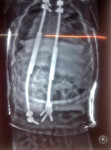 Figure 1
Scoliosis treatment such as performing definitive fusion too early may stunt growth. The growing rod is a suitable scoliosis treatment option to control spinal curves until the child is more mature for final definitive fusion (Figure 1). Growing rods need to be lengthened periodically every 6–12 months. A modification of this method is the use of the SHILLA procedure, where periodic lengthening is not routinely required. Another option is the use of VEPTR (vertical expandable prosthetic titanium rib), which has bony anchors on the rib cage instead of the spine. This method is useful if the child also has associated developmental issues involving the lungs and rib cage.
Minimally Invasive Correction of Scoliosis
In selected cases of scoliosis where there is only one significant curve to be operated on, minimally invasive methods may be used to correct scoliosis. This can be done through small incisions with the help of real-time X-ray imaging.
Correction of Severe Scoliosis
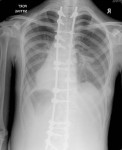
Correction of severe scoliosis often involves lengthy procedures and may include front and back approaches, as well as major bony resection (Figure 2). Sometimes, scoliosis surgery may have to be staged, i.e. two surgeries performed 5 to 7 days apart to allow the body to recover before the next surgery.
Sometimes, in the intervening period between two surgeries, traction (pulling force) may be applied to the spine in order to achieve some correction before the second operation.
Occasionally, the child may be admitted before the first surgery to apply traction.
Degenerative Scoliosis in Adults: Decompression and Fusion
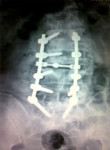
Degenerative scoliosis, i.e. scoliosis occurring in middle-aged and elderly individuals, is increasingly seen due to the aging population. It can be disabling as it causes deformity, back pain, and leg pain due to “pinched” nerves. If you are in this group and have not improved significantly with conservative treatment and spinal injections, surgery may be considered if your medical condition permits. Preoperative evaluation will be conducted to assess your fitness for surgery.
In such cases of a long-standing “crooked spine” (Figure 3), common complaints include back pain, stiffness, and fatigue, as well as progressively worsening leg symptoms such as numbness or pain. The leg symptoms occur because of gradually worsening nerve compression from bulging discs, swollen joints of the spine, bone spurs, and thickened ligaments of the spine. Increasing pain, tingling, numbness, and/or weakness may gradually affect the quality of life of the patient.
Hence, the objective of scoliosis surgery in such cases is to free the nerves from external compression, thereby allowing a better environment for nerve recovery. Stabilization using titanium screws and rods may be needed to hold the crooked spine and prevent it from bending further. With modern surgical methods, the crooked spine can often be made less prominent after surgery, with improvement in the balance of the spine and surrounding muscles, as well as improved body image.
There are variations in the surgical methods used to address this increasingly common problem in the aging population. The simplest surgical option is freeing the nerves from compression without additional stabilization. This is usually done very selectively, as only a minority of crooked spine cases are suitable for this option. The most common option involves decompression of the affected nerves as well as stabilization of the levels affected by nerve compression, without addressing the entire deformity of the spine. The third option involves freeing the nerves as well as stabilizing the entire spinal deformity. In some cases, bone resection at the most severe portion (apex) is performed to correct the deformity.
When to See a Spine Surgeon
Patients with scoliosis should consider seeking assessment from a spine surgeon if they experience persistent back pain despite conservative treatment, progressive spinal deformity or worsening posture, leg numbness or weakness, reduced walking tolerance, or increasing difficulty performing daily activities. Early evaluation by a spine surgeon helps determine the severity of the spinal deformity and whether monitoring, non-surgical treatment, or surgery may be appropriate.

|
Dr Hee Hwan Tak
Orthopaedic Surgeon & Spine Specialist MBBS (Singapore) | FRCS (Edinburgh) | FRCS (Glasgow) | FAMS (Ortho) |
| View Dr Hee Hwan Tak’s Profile → |